The White Tiger Fraud
Did you know that the only way to produce a white tiger is through severe inbreeding of brother to sister, father to daughter and mother to son?
Did you know that there is no such species as a Royal White Bengal Tiger?
If you didn't know that, don't feel bad, you were deceived just like millions of others. Read on to learn the truth about white tigers, white lions, tabby tigers and other genetic aberrations.
To see a 5 minute video clip about the rescue of the white tiger on this page, some baby cubs and others click HERE.
Over the years many people have asked us to take white tigers off their hands, but in every case it was only so they could breed more, so we declined. For years we have railed against supporting facilities that breed and exhibit white tigers because of the abuse involved in producing them. White Tigers can ONLY exist in captivity by continual inbreeding, such as father to daughter, brother to sister, mother to son and so forth. The white lions and golden tabby tigers are merely a product of this practice of inbreeding for white coats as well and are not being bred for any sort of conservation program either. (See genetics and time line of the inbreeding below)
The myth of the Rare White Bengal Tiger was an illusion meant to deceive the public into thinking that these cats were endangered and being preserved for future generations. The truth of the matter is that they aren’t even pure Bengal tigers, but rather are all the offspring of an original Siberian / Bengal cross breeding. The inbreeding results in many defects, early deaths, still births and, as could be expected, the cats are not very bright which is why they are preferred for entertainment purposes.
To quote from Dr. Ron Tilson, Conservation Director of the Minnesota Zoo and manager of the world renown Tiger Species Survival Plan, "The white tiger controversy among zoos is a small part ethics and a large part economics. The tiger Species Survival Plan has condemned bre eding white tigers because of their mixed ancestry, most have been hybridized with other subspecies and are of unknown lineage, and because they serve no conservation purpose. Owners of white tigers say they are popular exhibit animals and increase zoo attendance and revenues as well. The same rationalization can be applied to the selective propagation of white lions, king cheetahs and other phenotypically aberrant animals."
| "White tigers are an aberration artificially bred and proliferated by some zoos, private breeders and a few circuses who do so for economic rather than conservation reasons." |
"However, there is an unspoken issue that shames the very integrity of zoos, their alleged conservation programs and their message to the visiting public. To produce white tigers or any other phenotypic curiosity, directors of zoos and other facilities must continuously inbreed father to daughter and father to granddaughter and so on. At issue is a contradiction of fundamental genetic principles upon which all Species Survival Plans for endangered species in captivity are based. White tigers are an aberration artificially bred and proliferated by some zoos, private breeders and a few circuses who do so for economic rather than conservation reasons."

| ...most have such profound birth defects, such as immune deficiency, scoliosis of the spine (distorted spine), cleft palates, mental impairments and grotesquely crossed eyes that bulge from their skull... |
Consider this: Only 1 in 4 tiger cubs from a white tiger bred to an orange tiger carrying the white gene are born white, and 80% of those die from birth defects associated with the inbreeding necessary to cause a white coat. Of those surviving, most have such profound birth defects, such as immune deficiency, scoliosis of the spine (distorted spine), cleft palates, mental impairments and grotesquely crossed eyes that bulge from their skull that only a small percentage are suitable for display. Due to these birth defects the white tigers often die an early death. According to some tiger trainers, only 1 in 30 of those white cats will consistently perform. The number of tigers that have to be produced and disposed of in order to fill the public’s desire to see white tigers on display is staggering.
Big Cat Rescue has never taken in a white tiger before because we did not want to enable people to dispose of their “defective” cats and cause so much more suffering and abuse by having an easy dumping ground for the cats who didn’t serve them.
Even though Zabu is black and white, the decision of whether or not to rescue her was not. When Zabu and Cameron’s plight came to our attention we had to think long and hard about whether or not we would have a white tiger on our tour. We didn’t want to be perceived as using a white tiger to draw visitors.
Many times on our tours we tell guests about the fraud that has been promoted to the public about white tigers and talk about all of our golden tigers who ended up unwanted and abandoned at our door because they were the wrong colour. Now we were considering turning away a white tiger because she was the wrong colour. In her case the facility was being shut down and by rescuing her we were not enabling the owner to breed more and we were keeping a cat of prime breeding age from falling into the hands of people who would breed her to death.
Every year we have to turn away hundreds of big cats. Please do not support those who breed these majestic animals for a life of cruel confinement. No animal, especially a tiger, belongs in a cage.
Carole Baskin, Founder Big Cat Rescue
The White Tiger Fraud by Dan Laughlin, DVM, PhD.
I would like to take this opportunity to offer a very relevant fact regarding all the white tigers that are currently in the U.S. About twenty-five years ago I fully researched and documented the accurate genealogy and origin of the white tiger in the U.S. That research revealed that there were and are two separate origins of white tigers. The one that has received all the attention is the Indian or Bengal tiger bloodline which originated in India and entered the U.S. via a breeding loan to the National Zoo. One of the Indian origin tigers carrying the recessive gene for the white color was the mother of the second litter of white tigers born at the Cinncinnati Zoo in 1976. 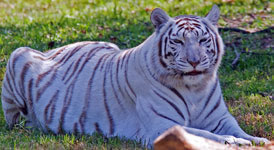
The original litter of white tigers born at Cincinnati in 1974 and all subsequent Indian origin bloodline white tigers soon died out in the U.S. without leaving any pure Indian origin Bengal white tigers in the U.S.
What is not known, because I have never published my research definitively showing the true origin of the white tiger in the U.S., is that there is a second and separate origin of the white tiger which occurred spontaneously in two separate private collections in this country when both owners inbred brothers to sisters that were all offspring of two litters resulting from crossing a pure Siberian male and a Bengal female at a small zoo in South Dakota.
Of the twelve live cubs born to the Siberian male and Bengal female at that small zoo, one of the private individuals purchased a litter of two cubs, a brother and sister, and the other individual purchased another litter of five cubs, brothers and sisters, through an animal dealer. Both individuals inbred their brothers and sisters and spontaneously had white tiger cubs born. One white male crossbred tiger, half-Siberian and half-Bengal, was placed on loan to the Cincinnati Zoo where he was crossed with a white carrier female Bengal tiger on loan from the National Zoo. That hybrid crossing in 1976 of the two separate white tiger origin bloodlines produced a litter of four white tiger cubs and one normal colored white carrier cub.
| "the Zoo proceeded to repeatedly inbreed... the white male to his white female sister... Thus, every white tiger ever born at the Cincinnati Zoo is part Siberian tiger and part Bengal tiger... It is those offspring which have been disseminated throughout the U.S." |
The Cincinnati Zoo then returned both parents and three of the cubs to the two exhibitors that had placed their adults there on loan and then the Zoo proceeded to repeatedly inbreed back and forth the white male to his white female sister that the Zoo had retained ownership of for themselves. Thus, every white tiger ever born at the Cincinnati Zoo was and is part Siberian tiger and part Bengal tiger to a greater or lesser degree.
It is those offspring which have been disseminated throughout the U.S. One of the individuals who owned the litter of five brothers and sisters representing the American crossbred white tiger bloodline has continued to inbreed his tigers for
over the past twenty-five years even though his neonate mortality rate has often exceeded eighty per cent and his tigers are severely defective and unfit. By pure chance and against overwhelming odds, when the two separate bloodlines, the
Indian and American, were crossed for the first and only time at the Cincinnati Zoo, the offspring were fairly thrifty and of normal birth weight. Interestingly, anyone with even cursory experience with and knowledge of the five remaining and endangered subspecies of tigers should be able to simply look at the white tigers throughout the U.S. and clearly see the phenotypic Siberian characteristics present in the cats. Some weigh up to seven hundred pounds and most clearly resemble and exhibit Siberian tiger physical characteristics.
The only conceivable legitimate reason for exhibiting a white tiger would be for educational purposes to clearly and unequivocally illustrate to the public the process of natural selection and how, when a deleterious recessive genetic mutation randomly occurs that is disadvantageous for the survival of the animal, such as white color in a tropical jungle environment, the animal does not survive to pass on that genetic mutation or disadvantageous characteristic to its offspring.
This was the normal course of natural selection and evolution of the tiger until a young white tiger male was captured in 1951, raised and then inbred to one of his daughters by a Maharajah in India who had captured him. Then, in the early 1970's, the recessive genetic mutation for the white color was present in both the male Siberian tiger and the female Bengal tiger that were exhibited and bred at the small zoo in South Dakota resulting in the origin of the American white tiger bloodline.
To quote from Dr. Ron Tilson, Conservation Director of the Minnesota Zoo, "The white tiger controversy among zoos is a small part ethics and a large part economics. The tiger Species Survival Plan has condemned breeding white tigers because of their mixed ancestry, most have been hybridized with other subspecies and are of unknown lineage, and because they serve no conservation purpose. Owners of white tigers say they are popular exhibit animals and increase zoo attendance and revenues as well. The same rationalization can be applied to the selective propagation of white lions, king cheetahs and other phenotypically aberrant animals." "However, there is an unspoken issue that shames the very integrity of zoos, their alleged conservation programs and their message to the visiting public. To produce white tigers or any other phenotypic curiosity, directors of zoos and other facilities must continuously inbreed father to daughter and father to granddaughter and so on. At issue is a contradiction of fundamental genetic principles upon which all Species Survival Plans for endangered species in captivity are based. White tigers are an aberration artificially bred and proliferated by some zoos, private breeders and a few circuses who do so for economic rather than conservation reasons."
| "...every white tiger in the U.S. is not only the result of repeated inbreeding of genetically defective animals but, even worse, is a hybrid or crossbred animal." |
Dr. Tilson made these comments before I informed him that all the white tigers in the U.S. are crossbred or hybrid animals, part Siberian and part Bengal. So, in conclusion, every white tiger in the U.S. is not only the result of repeated inbreeding of genetically defective animals but, even worse, is a hybrid or crossbred animal. Thus, anyone involved in breeding and/or exhibiting white tigers is doing a great disservice to honest conservation and preservation efforts to save the five remaining and endangered subspecies of tigers barely clinging to survival in their rapidly diminishing natural habitats.
| "anyone involved in breeding and/or exhibiting white tigers is doing a great disservice to ... conservation ... efforts to save the 5 ... species of tigers..." |
The genealogical misrepresentation, repeated inbreeding, exhibition and sale, for $60,000 each, of white tigers by the Cincinnati Zoo initiated the greatest conservation deception of the American public in history. That deception continues through today. In my view, exhibiting and breeding white tigers is the very antithesis of conservation, is dishonest and unethical and is tantamount to catering to the public's desire to see genetic aberrations rather than educating the public regarding the incredible process of natural selection, how the unbelievable diversity of life has evolved on our planet throughout the past 50 million years and the crucial need for us to preserve natural habitats and stop the destruction of our global ecosystem if we desire to save any threatened or endangered species from extinction.
| This white tiger is not living on Easy Street! His 4 photos are to illustrate the facial deformities that typically accompany the white gene. You never see these "throw-away" cats on display in zoos |
I hope this information helps inform visitors to your website.
Sincerely,
Daniel C. Laughlin, DVM, PhD
Note: Dr. Laughlin is widely recognized internationally for his expertise in the care and management of zoological animals, especially zoological cats and elephants. He has an international consulting practice limited to zoological animals and when he completed his research into the accurate genealogy of the white tiger he had well over 250 tigers in his practice alone. He also completed a landmark four-year study in the 1970's determining the efficacy, dosage and safety of a modified-live trivalent FVRC-P vaccine for use on zoological cats.  That study included 224 zoological cats representing 19 different species and the results of that vaccination study have saved the lives of thousands of captive zoological cats. Dr. Laughlin has graciously agreed to be a Consultant for the care and management of our extensive collection of zoological cats at "Big Cat Rescue."
Chronology of the white Bengal tiger up until the death of Mohan:
1820: A white tiger was displayed at Exeter Change.
1915: White tiger cub captured by Maharajah Gulab Singh of Rewa. Upon its death it was gifted to King George V as a sign of India's loyalty to the crown.
25th May 1951: A forest labourer reported sighting a white tiger cub.
26th May 1951: The cub's mother and two of its three siblings were shot and killed.
27th May 1951: Maharaja Martand Singh captured Mohan.
30th May 1951: The cub escapes and a large party goes out to recapture it.
26th February 1952: A normal coloured tigress named Begum is captured.
10th April 1955: Begum produced a litter of a male and two female cubs. All were orange, as were all the cubs in her subsequent two litters.
December 1957: Mohan was mated with Radha, his four-year-old daughter from the second litter with Begum.
20th October 1958: Radha produced an all-white litter of a male and three female cubs. They were christened Raja, Rani, Sukeshi and Mohini. Subsequently:
The male and one female (Raja and Rani) were gifted to the National Zoological Gardens in New Delhi.
Mohini was transported to Washington D.C.
Sukeshi was kept for mating with Mohan and remained with him until he was withdrawn from breeding. Her son showed no interest in mating with her and after six years without success she too was transferred to the National Zoological Gardens in New Delhi where she died on the 2nd February 1975.
May 1964: Raja and Rani were mated. Rani gave birth to two white cubs, a male and a female. She mauled both and the female died. The male, 'Tippu' lost his tail and was hand-raised with great difficulty.
August 1965: Two white cubs born to Rani. Both die due to neglect.
19th December 1965: Three white cubs are born to Rani. They were left in her care for just over a month, at which point she lost interest and they were hand-raised. The female dies at the age of 17-months and one male dies on the 17th April 1967 during shipping to the United States.
Breeding of Rani continued and she produced a total of 20 cubs, all white.
19th December 1969: Mohan died aged 19 years 7 months. All captive white tigers descend from Mohan, which explains why they are so genetically inbred.
 White Tigers can ONLY exist in captivity by continual inbreeding, such as father to daughter, brother to sister, mother to son and so forth. This is because the white color is the result of a double recessive allele (gene) and thus the white color can only be produced by inbreeding one tiger carrying the recessive gene for the white color to another tiger carrying the same recessive gene. Before the five remaining species of tigers were pushed to the brink of extinction by the activities of humans, the random occurrence of one normal colored tiger carrying the recessive gene for the white color breeding to another normal colored tiger also carrying the recessive gene for white color, thus producing one or possibly two cubs possessing the double allele for the white color and consequently being born white, occurred about once in every 10,000 births. That statistical approximation is based upon recorded observations in the wild of white cubs. It should be noted that the first recorded observation of a white cub was made in the mid-fifteenth century and the only wild observations of white cubs have been in Bengal tigers.
Because the white coloration is so disadvantageous to survival there is no recorded evidence of a white cub ever living long enough in the wild to become an adult. That is why white tigers ONLY exist in captivity and then ONLY as the result of continual, destructive and unethical inbreeding. Thus, the concept of the "Royal Rare White Bengal Tiger" is a myth and likely the most deceptive misconception and most destructive conservation fraud ever perpetrated on the American public. The truth is that all the white tigers currently in the United States are not even Bengal tigers but are worthless hybrids or crossbreds originating from normal colored offspring born to a pure Siberian male tiger and a pure Bengal female tiger that were kept together during the 1960's at the Sioux Falls, S.D. Zoo. Unknown to the Zoo at that time or to the two private exhibitors who purchased cubs from two litters born at the Zoo, all the normal colored cubs carried the recessive gene for the white color because either or both their Siberian father or their Bengal mother was a or were random carriers of the recessive mutant gene. Thus when the two private exhibitors that purchased litter mates from the Sioux Falls Zoo unethically bred brother to sister, the recessive mutant genes were paired, producing one or two white tigers.
| "...private exhibitors have experienced neonatal mortality rates in excess of 80% because the recessive gene for the white color is a deleterious mutation..." |
Both private exhibitors have experienced neonatal mortality rates in excess of 80% because the recessive gene for the white color is a deleterious mutation and thus is co-linked to numerous other deleterious and often fatal characteristics such as immune deficiency, strabismus (crossed eyes), scoliosis of the spine (distorted spine), cleft palates, mental impairments and early death.
 The genetics of all recessive genes works like this:
If we assign, say a capital "N" to represent normal color in a tiger and a small "w" to represent white color (because the white color is recessive and the orange color is dominant), then a normal colored orange tiger would be represented as "NN" and a normal colored orange tiger carrying the recessive gene for the white color would be represented as "Nw." So, if we bred a normal colored orange tiger to a normal colored orange tiger carrying the recessive gene for the white color, we would represent that cross as "NN" x "Nw" and the offspring would be represented as: half "NN" and half "Nw". In other words, one-half of the cubs would be normal orange color non-carriers and one-half would be normal color orange carriers of the recessive white gene.
Then, if the two normal color orange carriers of the white gene were bred to each other (brother to sister) the genetic representation would be: "Nw" x "Nw" and the offspring would be something like this: one-forth "NN", one-half "Nw" and one fourth "ww".
| You may have to click twice to start. This was done by a 16 year old girl who calls herself Crackle Caracal who did this as a class project. It is so purr-fect, we wanted you to see it. |
In other words, one out of four cubs, statistically, would be a a normal orange colored non-carrier cub ("NN"), one-half of the cubs would be normal orange colored carriers of the recessive white gene (2 "Nw") and one cub would be a double allele carrier of the white recessive gene ("ww") and thus be colored white.
But, when you cross a white male to a white female ("ww" x "ww") you can only have all white cubs born ("ww") and that is what The Cincinnati Zoo and individuals such as Siegfried and Roy have been doing for at least the past fifteen generations, always breeding for large size, thus unknowingly emphasizing the Siberian phenotypic or physical characteristics deriving from "Kubla," the pure Siberian male at the Sioux Falls, S.D. Zoo.
An unnatural fate
St. Petersburg Times; St. Petersburg, Fla.; May 27, 2001; LINDA GIBSON;
Abstract:
[Janie], a white Siberian tiger; Taking a cruise last weekend on Lake Seminole are, cubs Teddy and Emily, 5 months and about 75 pounds, and Nini, 11 months and 150 pounds, with owner [Vernon Yates], and his girlfriend Tina Pennington.; This tiger cub,; one of a litter of three - she yellow, the other two white males - was born in December at Wild Bill's Airboat Tours and Wildlife Sanctuary in Inverness.; [Susan MacKay] of Inverness holds a Siberian tiger cub; Photo: PHOTO, JILL SAGERS, (2); PHOTO, STEVE HASEL, (2)
The photo featured Susan MacKay, who along with her husband, Bill, runs Wild Bill's Airboat Tours and Wildlife Sanctuary in Citrus County, where they breed tigers.
"They were rare. Now everybody's got them," said Mitchel Kalmanson, an insurance broker in Maitland who specializes in animal and entertainment coverage. "Values have dropped so drastically on white tigers they're not worth insuring anymore."
Exact numbers are impossible to obtain, but owners of wildlife sanctuaries say there are far more cubs available than suitable places for them to live. Some are bought by people who think they can make pets of them. Sellers often encourage this misperception.
"We had to turn away 311 cats last year, mostly lions and tigers," said Carole Baskin, founder of Big Cat Rescue, a sanctuary for big cats in north Hillsborough County.
So what happens when the owners can no longer handle them?
When she arrived in 1997 at Vernon Yates' of Seminole, she was 4 years old and should have weighed about 400 pounds.
She weighed 100 pounds.
 "You know what a greyhound looks like? You could see her ribs. We didn't even have to hold her down to put an IV in her."
Through his company, Tiger Rescue Foundation, Eisenmann got the tigers to display at schools, churches, nursing homes and civic associations. In June 1997, he pleaded no contest to a charge of animal cruelty and was put on probation.
 Eisenmann's Tiger Rescue Foundation no longer exists. Because nobody ever paid Janie's boarding bill, Yates says, the tiger still lives with him.
Kalmanson said at least a dozen people in Florida breed white tigers for sale.
The MacKays advertise their cubs in a trade magazine called Animal Finders Guide. Among listings for elk calves, albino groundhogs, wolf cubs and wallabies is theirs:
There's one other issue. If tigers aren't suitable pets, what message does Yates send by taking them for rides on his boat?
He has been hurt just once, he said, when one of his tigers gave him a "love bite."
In Florida, it's against the law to own a tiger as a pet. But there are loopholes. If you're going to use a tiger for some commercial purpose, such as as a mascot for a business, or to educate the public, or to be photographed for movies or commercials, you can get a license to own a tiger. The animals also can be sold to buyers from states that don't regulate private ownership of non-native wildlife, such as Texas or Alabama.
Some people who buy or sell tiger cubs tend to be secretive. Even if properly licensed, they don't want to attract attention from neighbors or animal-rights activists.
St. Petersburg Times staff writer Linda Gibson can be reached at (813) 226-3382.
Click on the animations below to play big cat movie clips about the plights these cats face in the wild and in captivity
"SEMU"


